iPhone 17 Pro & iPhone Air share many similarities, but there are also important differences, such as quality, performance, features, design, and connectivity. If you want the best one between them, I Would recommend the iPhone 17 Pro rather than the iPhone Air.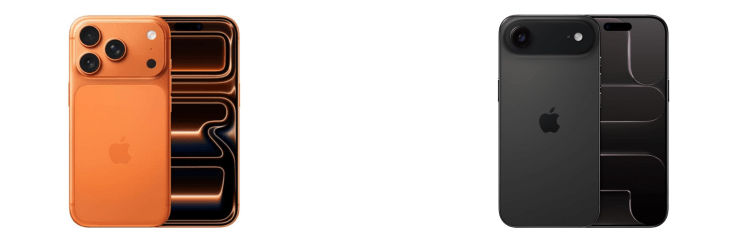
Why Do I Recommend The iPhone 17 Pro?
- The iPhone 17 Pro has a 6-core GPU within the A19 Pro chip to deliver smoother frame rates and better ray-traced graphics in demanding apps, while the iPhone Air features a 5-core GPU.
- iPhone 17 Pro features a triple-lens camera system with a dedicated telephoto lens for capturing distant subjects with true optical zoom and lossless detail, whereas the iPhone Air includes only a single wide-angle camera that relies on digital zoom.
- It comes with a vapor chamber cooling system to maintain stable performance during prolonged gaming or 4K video recording, while the iPhone Air uses standard passive cooling.
- The iPhone 17 Pro supports faster 40-watt wired charging for quicker top-ups during travel or work, whereas the iPhone Air supports a lower 20-watt wired charging rate.
- iPhone 17 Pro includes a larger battery rated for up to 33 hours of video playback for extended daily use without recharging, whereas the iPhone Air achieves about 27 hours due to its slimmer body.
- It comes with a more advanced rear camera module with an additional ultrawide sensor for landscape and macro photography, while the iPhone Air lacks a separate ultrawide lens.
- The iPhone 17 Pro features a premium stainless-steel frame for improved structural rigidity and scratch resistance, whereas the iPhone Air uses a lightweight titanium frame.
- It supports higher sustained brightness levels during HDR video playback to enhance contrast and visibility in bright environments, while the iPhone Air reaches slightly lower peak brightness due to thermal and power limitations.
Maybe the iPhone Air can make you comfortable because it’s a little bit cheaper than the iPhone 17 Pro. But you have to compromise all the above-mentioned features. Now the Decision is Yours. I hope it was helpful to choose the right one.
Side-by-Side Comparison
| Feature | iPhone 17 Pro | iPhone Air |
| Rear camera count | Triple | Single |
| Telephoto optical zoom | Yes | No dedicated telephoto lens |
| Cooling system | Vapor chamber cooling | Standard cooling (thin body) |
| Battery life (video playback) | Longer | Shorter |
| Charging speed | Wired faster + wireless up to higher wattage | Wired slower + wireless lower wattage |
| Build material / finish | Premium heavier build | Ultra-thin titanium frame design |
| Optical zoom capability | True telephoto with optical zoom | Only digital/crop, no telephoto lens |
| Weight vs portability trade-off | Heavier, more features | Much lighter, thinner, fewer features |
| Materials used | Aluminum unibody with Ceramic Shield-2 back | Titanium frame with Ceramic Shield front+back |
| Rear camera versatility | Wide + Ultra-Wide + Telephoto | Wide only |
| Price | Check iPhone 17 Pro Price | Check iPhone Air Price |
What Common Both Can Do?
- Processor: Both models feature Apple’s A19 Pro chip, delivering equally high CPU and neural engine performance for advanced AI tasks and graphics-intensive apps. This ensures smooth multitasking and longevity for future iOS updates.
- Display Type: Each phone uses an LTPO Super Retina XDR OLED panel that dynamically adjusts refresh rates for excellent color accuracy and power efficiency.
- Refresh Rate: Both support 120 Hz ProMotion, giving ultra-smooth scrolling, gameplay, and motion rendering compared to standard 60 Hz screens.
- Display Brightness: Each display reaches up to 2000 nits outdoors, ensuring excellent visibility in bright sunlight and HDR video playback.
- Front Camera Resolution: Both use a 12 MP TrueDepth camera that enables crisp selfies and Face ID facial recognition with fast depth mapping.
- Front Camera Features: The TrueDepth system on both supports autofocus, Photonic Engine image processing, and 4K HDR recording for consistent selfie and video-call quality.
- Main Camera Sensor: Both include Apple’s 48 MP Quad-Pixel sensor, providing higher detail, better low-light performance, and improved ProRAW image capability.
- Video Recording: Each can record in 4K HDR up to 60 fps, supporting cinematic modes and ProRes encoding for professional-grade video quality.
- Display Protection: Both employ Ceramic Shield Glass on the front for superior drop resistance and scratch protection compared to standard glass.
- Build Quality: Each uses premium metal and glass construction that feels solid, with precision-machined frames and seamless finish.
- Operating System: Both launch on iOS 18 with identical software features, including AI photo editing, on-device Siri intelligence, and advanced privacy controls.
- Connectivity: Both models support 5G networks, Wi-Fi 7, and Bluetooth 5.3, ensuring fast wireless communication and accessory compatibility.
- Port: Each device uses a USB-C port for charging and data transfer, enabling universal cable use and faster wired connections.
- MagSafe Compatibility: Both are MagSafe-enabled for precise magnetic alignment with accessories like chargers, wallets, and mounts.
- Face ID: Each uses Apple’s Face ID system for secure authentication and payments with the same sensor precision and speed.
- Water Resistance: Both hold an IP68 rating, protecting against dust and immersion in water up to 6 meters for 30 minutes.
- Storage Options: Both come in 128 GB to 1 TB variants, letting users choose the right capacity for photos, videos, and apps.
- Battery Chemistry: Each uses advanced lithium-ion cells with optimized charging cycles, balancing longevity and fast charging efficiency.
- Wireless Charging: Both support MagSafe and Qi2 charging standards, allowing reliable wireless power delivery and accessory use.
Common Features
| Feature | iPhone 17 Pro | iPhone Air |
| Processor | A19 Pro Chip | A19 Pro Chip |
| Display Type | LTPO Super Retina XDR OLED | LTPO Super Retina XDR OLED |
| Refresh Rate | 120 Hz (ProMotion) | 120 Hz (ProMotion) |
| Display Brightness | Up to 2000 nits (peak outdoor) | Up to 2000 nits (peak outdoor) |
| Front Camera Resolution | 12 MP TrueDepth | 12 MP TrueDepth |
| Front Camera Features | Autofocus / Photonic Engine / 4K video | Autofocus / Photonic Engine / 4K video |
| Main Camera Sensor | 48 MP Quad-Pixel | 48 MP Quad-Pixel |
| Video Recording | Up to 4K 60 fps HDR | Up to 4K 60 fps HDR |
| Display Protection | Ceramic Shield Glass | Ceramic Shield Glass |
| Build Quality | Premium metal and glass | Premium metal and glass |
| Operating System | iOS 18 | iOS 18 |
| Connectivity | 5G / Wi-Fi 7 / Bluetooth 5.3 | 5G / Wi-Fi 7 / Bluetooth 5.3 |
| Port | USB-C | USB-C |
| MagSafe Compatibility | Yes | Yes |
| Face ID | Yes | Yes |
| Water Resistance | IP68 | IP68 |
| Storage Options | 128 GB – 1 TB | 128 GB – 1 TB |
| Battery Chemistry | Advanced lithium-ion cell | Advanced lithium-ion cell |
| Wireless Charging | MagSafe / Qi2 | MagSafe / Qi2 |
| Price | Check iPhone 17 Pro Price | Check iPhone Air Price |
FAQ
Does the iPhone 17 Pro have better performance than the iPhone Air? Is the iPhone Air thinner than the iPhone 17 Pro? Do both models use the same processor? Which model has the better camera system? Do both support 5G and Wi-Fi 7 connectivity? Which phone lasts longer on a single charge? Do both support fast charging and MagSafe? Do both use a USB-C port? Are they both water-resistant? Do both support the same display technology? Which model is better for photography enthusiasts? Do both run the same iOS version? Who should choose the iPhone Air over the iPhone 17 Pro? |